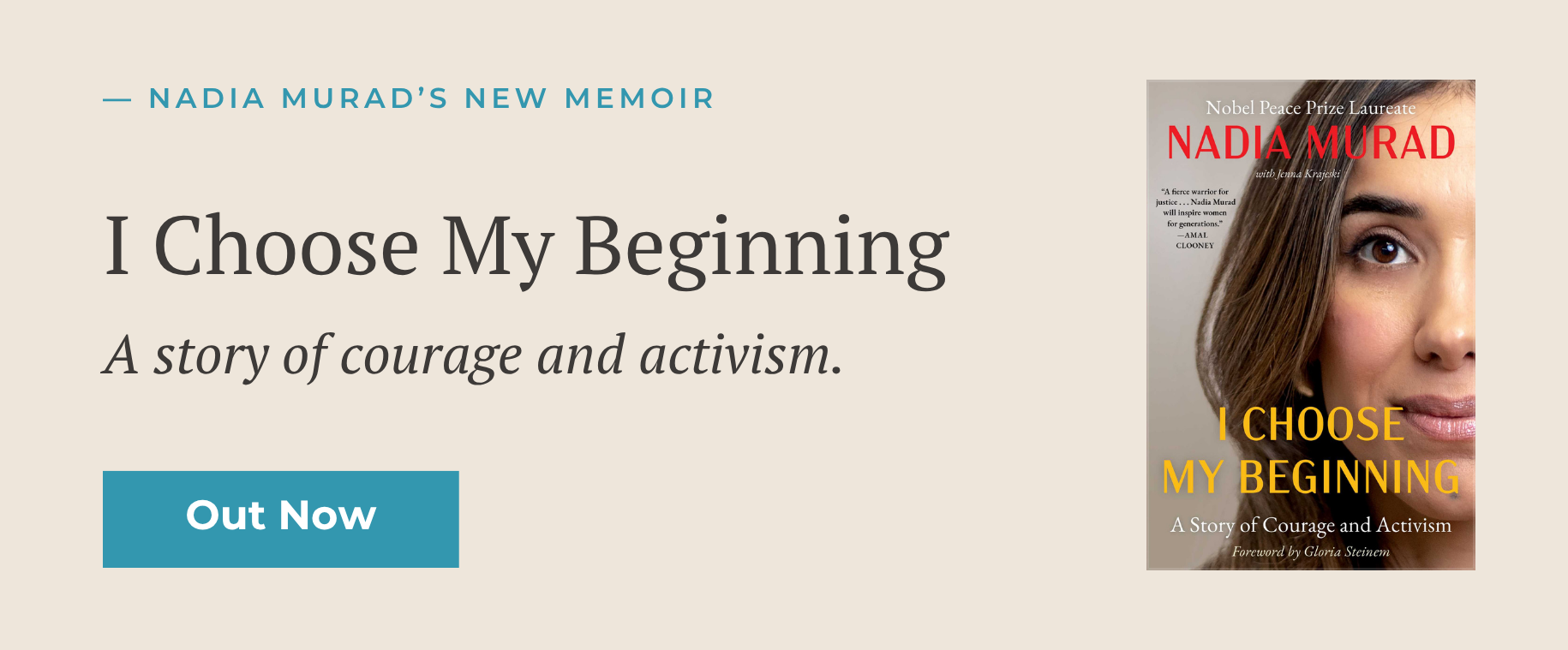
Nadia Murad's second book, I Choose My Beginning: A Story of Courage and Activism, is out today. Published by Summit Books, it opens with a foreword by Gloria Steinem.
The Last Girl told the story of what ISIS did to Nadia, her family, and the Yazidi community in 2014. I Choose My Beginning picks up where that book left off, tracing Nadia's journey in the decade since. Those were the years she spent in the halls of international institutions and in courtrooms demanding justice for survivors, and the same years she spent learning how to be a university student, a friend, and a wife. The book brings those two lives together, and carries the memory of those she lost, and those who survived, into both.
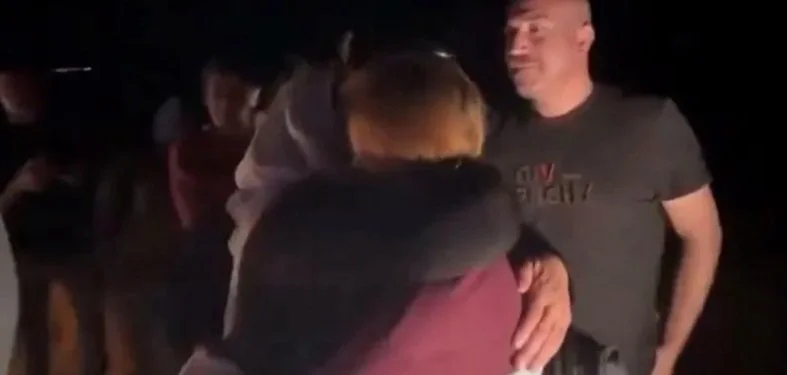
Nadia Murad and Sheryl Sandberg's TIME Op-Ed: After more than a decade in captivity, Fawzia Amin Sido was rescued from Gaza, returned to Iraq, and reunited with her family on Oct. 2. Fawzia’s freedom is a reminder that thousands of women and children remain in captivity. The international community has failed, time and again, to bring them home and to hold everyone who contributed to these crimes against humanity accountable.
Nadia Murad’s CNN Op-Ed: Thoughts and prayers. Promises of "never again." They are not enough. Seven years after ISIS committed genocide against the Yazidi community, my ethno-religious minority, in Iraq, hundreds of thousands of people remain internally displaced and more than 2,800 women and children remain missing.
As the trauma of genocide continues in the absence of sufficient support for Yazidis, it is critical the world does not look away. Read Nadia’s Initiative’s press statement on the 7th Anniversary of the Yazidi Genocide.
Nadia Murad’s Newsweek Op-Ed: Earlier this year, at the burial ceremony for more than 100 Yazidi victims of ISIS' massacre in my hometown of Kocho, Sinjar, Iraq, members of my community asked me to deliver a speech.
Nobel Peace Prize laureate Nadia Murad grants an interview to Vatican Media about Pope Francis’ recent Apostolic Journey to Iraq, saying it sent an important message of hope for minorities in the nation, especially for the Yazidis.
Nadia Murad’s The Guardian Op-Ed: Staring at the same four walls day after day, unable to find work, reunite with relatives, or send your children to school. The Covid pandemic has rendered this bleak picture a reality for many people across the globe. Yet for many who have survived or are living through conflict, these hardships are hardly novel.
“We now have the legal precedent to take conflict-related sexual violence seriously and to prosecute it.” Nadia Murad discusses the future of aid in the New Humanitarian.
Nadia Murad sat down for an interview for the "Seeking Peace" podcast, a production of Georgetown University's Institute of Women, Peace, and Security. Nadia Murad spoke to host Melanne Verveer about the progress made to support the Yazidi community, and the work that remains to seek justice for Yazidis and ensure peace in the region.
On World Day Against Trafficking in Persons, Nadia Murad spoke to Trevor Noah on the Daily Show about the ongoing plight of the Yazidi community and the needs of survivors of sexual violence.
On World Day Against Trafficking in Persons, Nadia Murad speaks to Women Political Leaders about the importance of supporting survivors and having survivors lead the work that benefits them.
Erbil/Sinjar — Nearly six years after the Yazidi genocide, up to 200,000 Yazidis are still displaced, many living in camps only hours away from their homeland of Sinjar, in Iraq’s Ninewa Governorate. Despite previous low levels of return, June 2020 saw a marked increase in the return of displaced families to Sinjar.
Nadia Murad’s Thomson Reuters Foundation Op-Ed: Women are often on the frontlines of those most vulnerable during crisis situations. They are targets of gender-based violence (GBV) in war, conflict, economic crises, disasters, pandemics, and in their everyday environments.
Step it up G7: An extraordinary time requires extraordinary solidarity. Desperate times require bold and determined leadership. The COVID-19 virus represents a common challenge to the whole world and, like never before, reminds us of our interdependence.
“We, the United Nations (UN) Secretary-General’s Sustainable Development Goals (SDG) Advocates and Alumni, are greatly concerned by the novel coronavirus outbreak (COVID-19) and the impacts it is having in every corner of the globe. We stand in solidarity with those affected…”